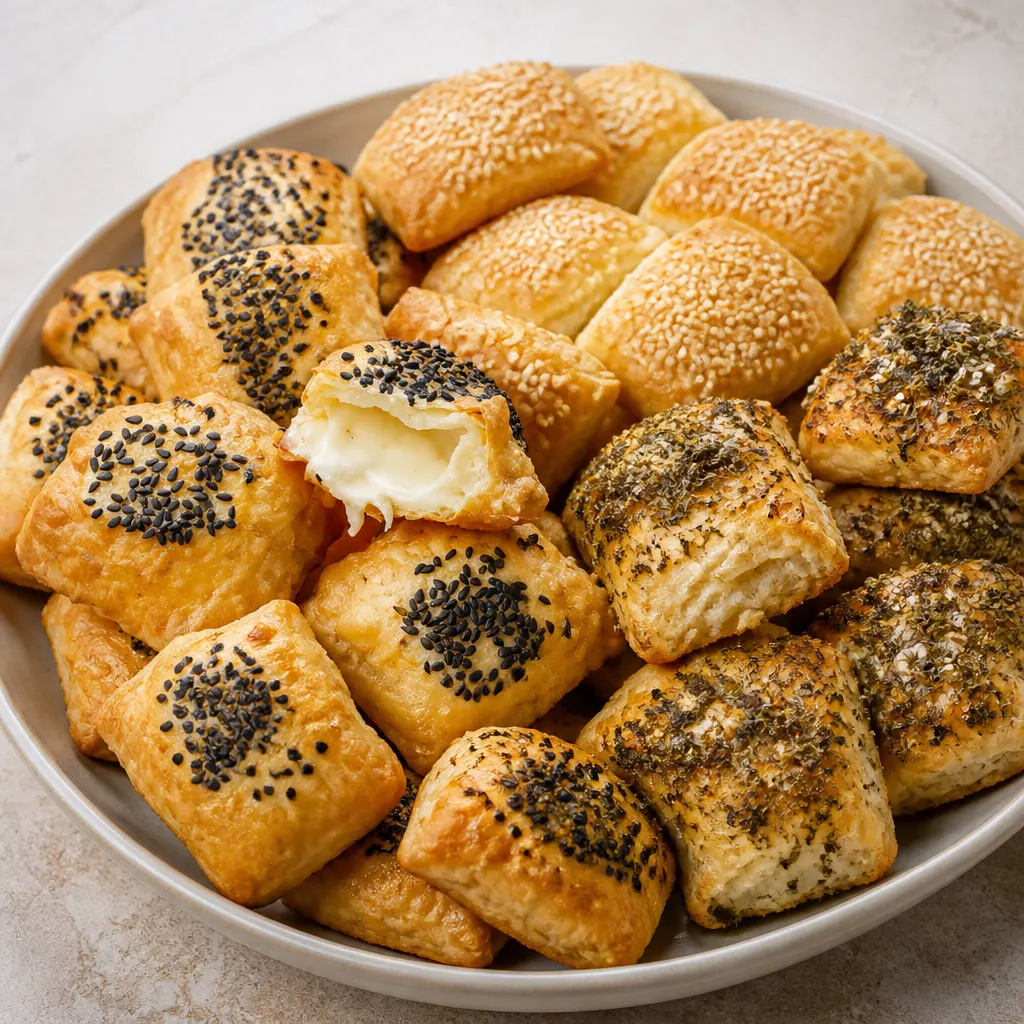
Ramadan Cheese Pies with Three Types of Dough
Small cheese pastries prepared for Ramadan using three types of dough.
Small baked cheese pies made for Ramadan using three different doughs.
Like mixed cheese hand pies or savory pastries.
Ingredients
- 2 cups 400 g Flour
- half cup 120 ml Water
- a pinch Salt
- 1 tsp Ghee
- 1 tsp Sugar syrup (sheera) or sugar
- half kilo Halloumi or low-salt braided Akkawi cheese
- 1 small bunch Parsley
- 1 tsp Sesame seeds
- 1 tsp Nigella seeds
- 1 Ready-made mille-feuille dough
- 2 Ready-made yufka or sambousek dough
- a drop Vegetable oil
- a little Extra flour for rolling out
- 3 tsp flour and a little water Flour-and-water sealing mixture
- enough to submerge Oil for frying
- as an option Shallal cheese
Instructions
- Place 2 cups of flour in the mixing bowl.
- Add 1 teaspoon of ghee and 1 teaspoon of sugar syrup (sheera) or sugar to the mixing bowl.
- Rub the ingredients together in the mixing bowl until the ghee and syrup are distributed through the flour.
- Add a pinch of salt to the mixing bowl.
- Add half a cup of warm water to the mixing bowl and stir the ingredients until a dough forms.
- Knead the dough in the mixing bowl or on the work surface with a drop of vegetable oil until it is smooth, soft, and no longer sticky.
- Place the dough in a bag, seal it, then refrigerate for half an hour to rest.
- Finely chop half a kilo of Halloumi or low-salt braided Akkawi cheese in the filling bowl.
- Finely chop 1 small bunch of parsley, then add it to the filling bowl.
- Add 1 teaspoon of sesame seeds and 1 teaspoon of nigella seeds to the filling bowl, then mix the filling.
- Shape the cheese filling into pieces suitable for stuffing, arrange them on a tray, then place the tray in the freezer until frozen.
- Remove the dough from the refrigerator and roll it out on a floured work surface.
- Cut the dough into circles on the work surface using a cutter or suitable lid.
- Place a piece of cheese filling inside each dough circle.
- Seal the dough circles using a borek mold or by pressing by hand, then arrange the pieces on a plate or in a suitable container.
- Flour may be placed beneath the borek pieces in the container intended for freezing; seal it well so they do not dry out in the refrigerator or freezer.
- Take out the mille-feuille dough and leave it on the work surface until it softens slightly and can be worked with.
- Prepare the sealing mixture in a cup or small bowl by mixing 3 teaspoons of flour with a little water until it is slightly runny.
- Lay a sheet of mille-feuille dough widthwise on the work surface.
- Place portions of cheese filling, spaced apart, on the mille-feuille dough.
- Brush the sealing mixture onto the mille-feuille dough where it will be sealed.
- Fold one edge of the mille-feuille dough over the filling and seal the edges by hand.
- Cut the mille-feuille dough on the work surface using a serrated or zigzag tool, then arrange the pieces on a tray.
- Sesame seeds or nigella seeds may be sprinkled over the borek pieces after shaping so they adhere to the dough.
- Use the ready-made yufka or sambousek dough as is on the work surface for quick shaping.
- Place the cheese filling in the center of the yufka or sambousek dough on the work surface.
- Roll the yufka or sambousek dough around the filling and seal it well.
- Pour enough oil to submerge into a frying pan over the heat.
- Remove the borek pieces from the freezer after about an hour, once frozen, before frying.
- Fry the borek pieces in the pan over medium heat when the oil reaches 190°C.
- Remove the borek pieces from the pan as soon as they reach the desired color so the cheese does not spill out from inside as it melts further.
- Serve the cheese pastries hot.